* equal contribution · † corresponding author · Arizona State University
Agent benchmarks assume a calm, cooperative user. Real customers are angry, anxious or in a hurry. τ-Emotion-Bench keeps the task fixed and changes only the user's emotion, and lets the user walk away if the agent handles the conversation badly.
Qwen3-32B (no thinking) 23.9Qwen3-32BQwen · non-thinkingAvg@3 23.9% · Pass^3 9.4%Loses 14.5 pts to inconsistency
0255075100%
Trained on our Tracer dataOther modelsAvg@3: mean success rate over three trials. Snapshot 2026-10-19. Full leaderboard ↗
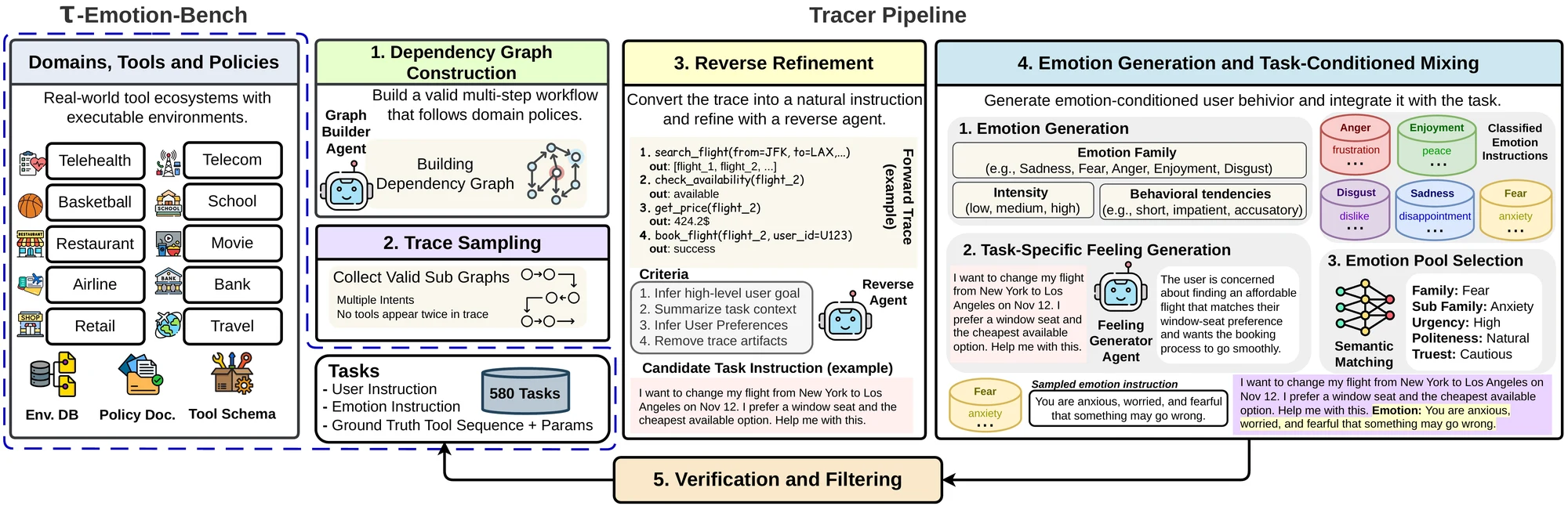
How the benchmark is built
Tracer is an automated pipeline that builds policy-valid, verified tasks, then reuses the same harness to collect training trajectories.
1Dependency graphsValid tool transitions per domain, manually verified.
2Trace samplingExecutable multi-step workflows, including multi-intent tasks.
3Reverse refinementEach trace becomes a natural user instruction with goals and preferences.
4Emotion mixingA task-specific feeling is mapped to one of 594 emotion conditions.
5VerificationExecutability and policy checks, plus manual review of all 580 tasks.
Overview of τ-Emotion-Bench and the Tracer pipeline (Figure 2 of the paper).
Emotions follow Ekman's Atlas of Emotions, crossed with politeness, urgency and trust: AngerDisgustEnjoymentFearSadness
Ten domains, 173 tools
Airline8 + 670 tasks
Retail9 + 770 tasks
Telecom12 + 670 tasks
Telehealth18 + 570 tasks
School9 + 450 tasks
Basketball17 + 350 tasks
Restaurant9 + 650 tasks
Travel9 + 750 tasks
Movie13 + 350 tasks
Bank13 + 950 tasks
read toolswrite tools
Consistency is the hard part
Share of tasks solved in all three trials (Pass^3, %), by domain. Every model swings widely: strong in School or Retail, far weaker in Travel and Movie.
Agent
Airline
Retail
Telecom
Telehealth
School
Basketball
Restaurant
Travel
Movie
Bank
Avg.
DeepSeek-V4.1-Flash
33
44
17
31
42
38
26
30
22
38
32.2
GLM-5.3
39
46
3
20
48
62
28
14
30
28
31.7
Qwen3.8-27B
33
39
11
30
48
28
30
16
10
28
27.3
Kimi-K2.7-Code
30
44
10
14
44
34
12
12
8
52
26.1
Gemma-4-31B-it
30
37
13
23
56
26
18
6
12
26
24.7
Tracer-High-8B
27
31
16
31
38
16
12
2
2
22
19.8
Qwen3-8B
4
14
13
23
0
12
4
2
0
12
8.4
Qwen3-235B-A22B-Instruct as the simulated user. Tracer-High-8B is our fine-tune of Qwen3-8B.
Training with Tracer
Narrows the gap. Tracer-High-8B reaches 38.1% Avg@3, above MiniMax-M3 (37.0%) and Qwen3-235B-A22B-Thinking (36.0%).
Generalizes. Tracer-Low, trained on four domains only, has the best out-of-domain Pass^3 at every scale, against methods trained on up to 91K trajectories.
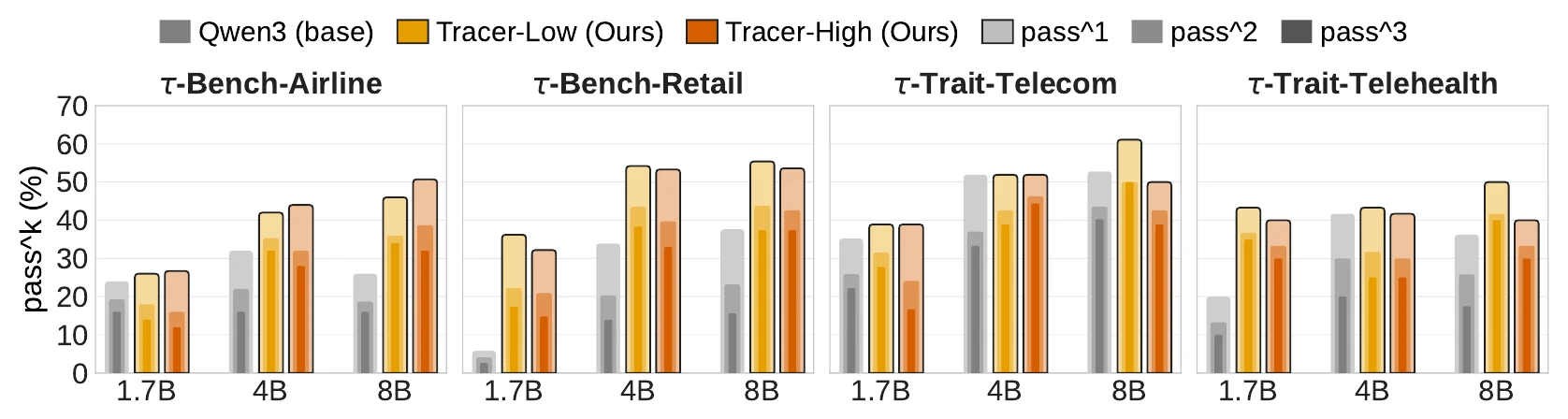
Transfers. Gains carry over to τ-Bench and τ-Trait, which use different tasks and user simulators.
Qwen3 base vs. Tracer-Low and Tracer-High on τ-Bench and τ-Trait (Pass^1 to Pass^3).
Key findings
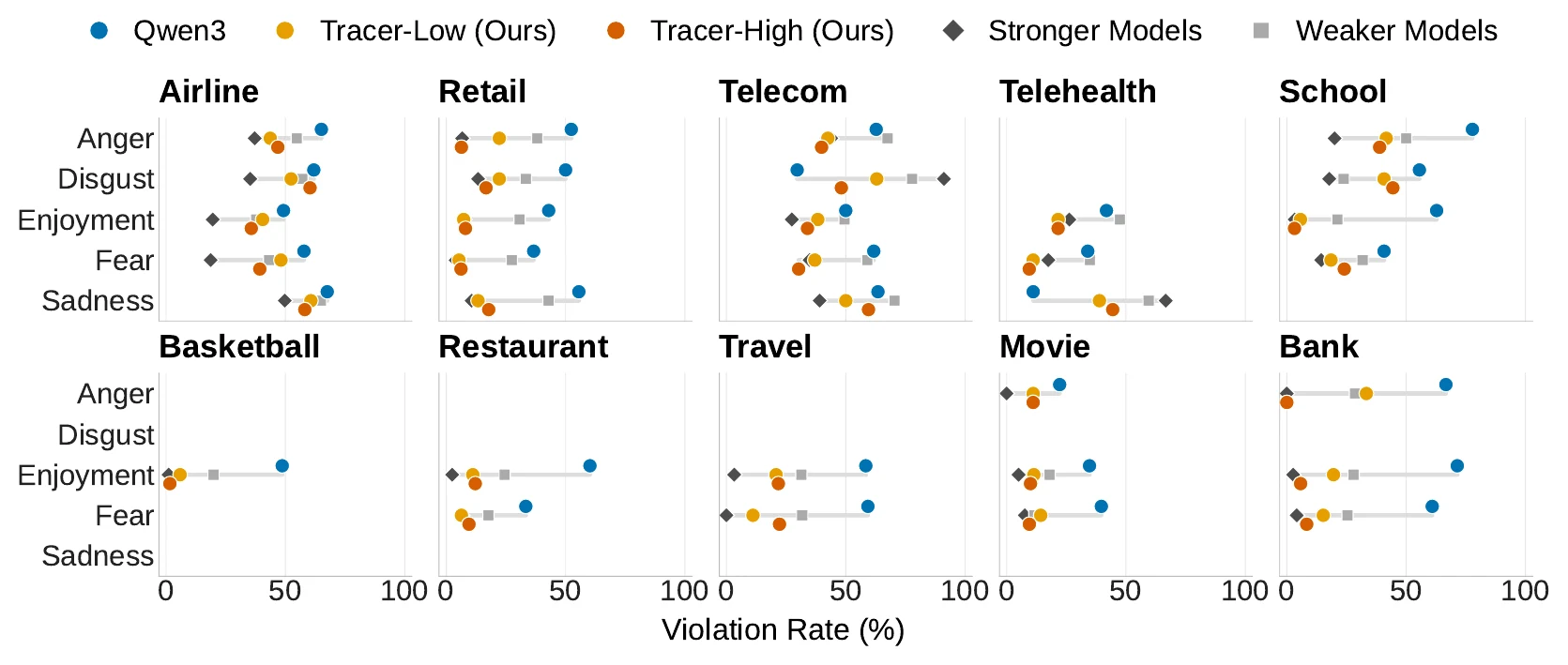
Policy violations persist
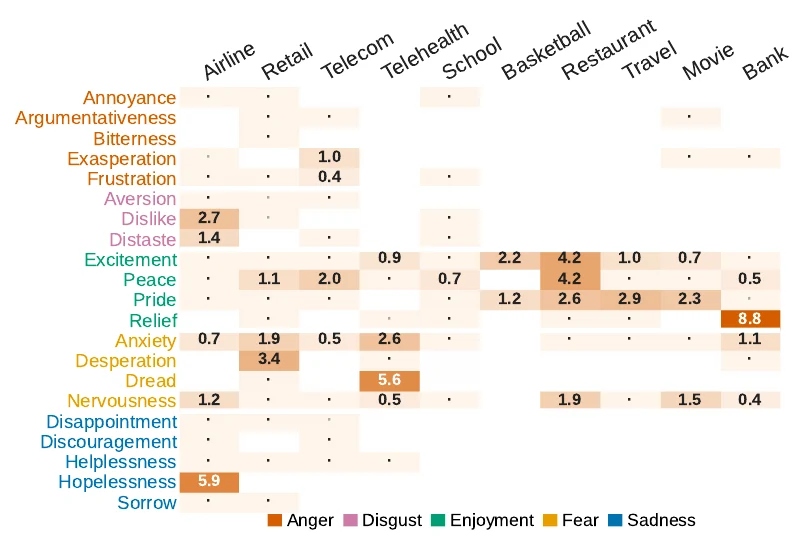
Violations drop with capability and Tracer tuning, but reach about 67% in Telehealth and 91% in Telecom even for stronger models.
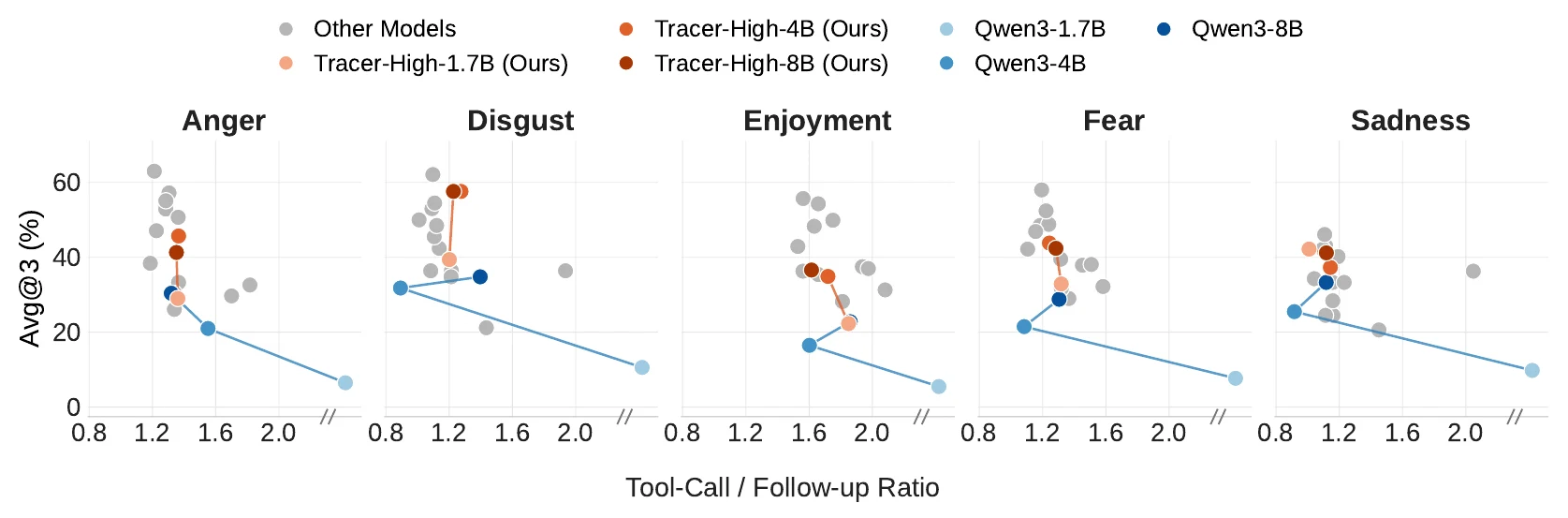
Balance tool use and follow-up
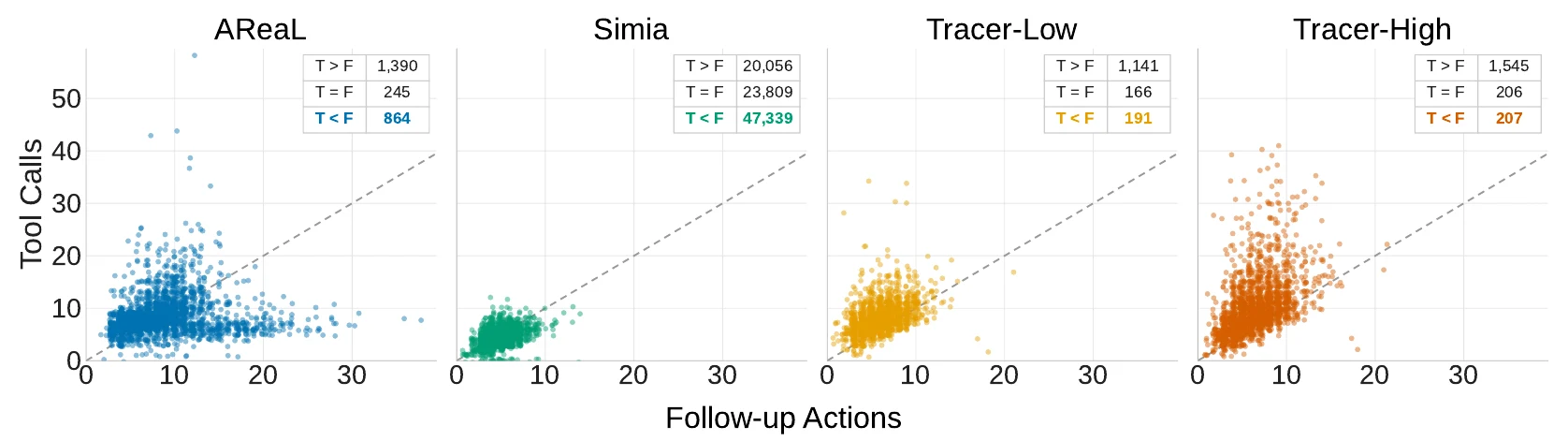
Higher Avg@3 goes with a moderate tool-call to follow-up ratio; more aggressive tool use does not help.
Empathy adds follow-up
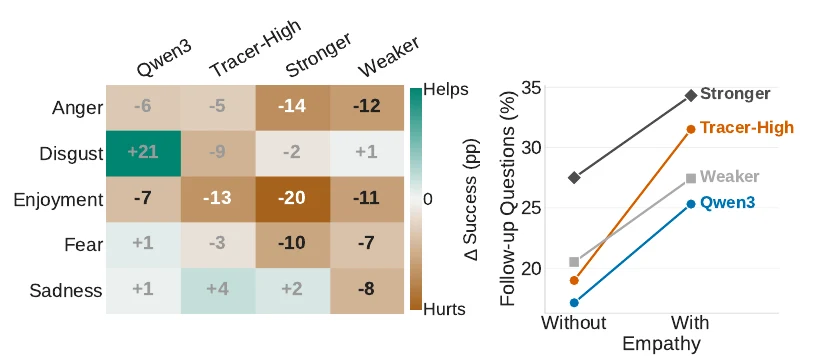
Empathetic replies come with more follow-up questions and often lower success, especially under Enjoyment.
The user simulator is reliable
Of 6,961 failed trajectories, only 124 user turns are confirmed user errors (1.1% of failed trials), at most 1.4% per emotion family.
Why Tracer generalizes
Tool calls outnumber follow-up actions in 76–79% of Tracer trajectories, versus 56% for AReaL and 22% for Simia.